I run into the same cashflow squeeze scenarios with clients again and again: sales are steady, but supplier bills land in clusters and the bank balance gets tight just when payroll needs to go out. One of the most practical fixes I’ve found is a rolling 13-week supplier payment plan. It smooths out outflows, makes forecasting reliable and—if handled well—wins supplier buy-in without eating into your margins.
Below I share how I set these plans up in the real world: the forecasting logic, negotiation language that works, operational steps, KPIs to watch and how to avoid common pitfalls. This is step-by-step and pragmatic; you can adapt it to a sole trader or a small limited company with a handful of regular suppliers.
Why a 13‑week rolling plan?
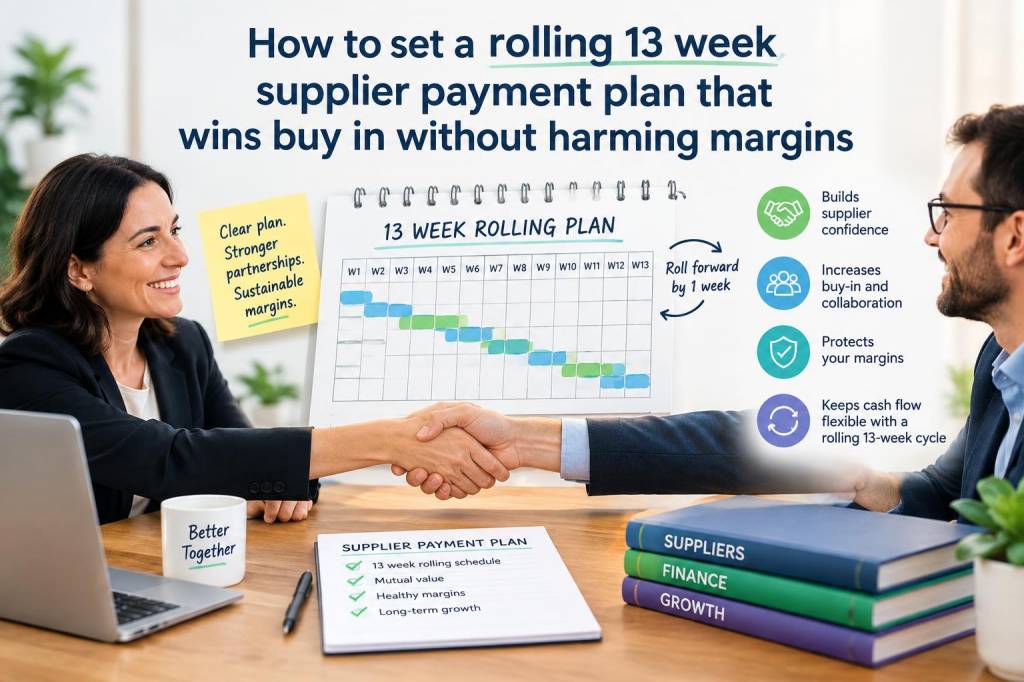
Thirteen weeks gives you a full quarter of visibility while keeping the plan flexible. It’s long enough to move larger payments into manageable instalments, yet short enough that suppliers still see progress and predictability. A rolling approach means each week you drop the oldest week and add a new one at the end, so the plan always covers the next 13 weeks.
For suppliers, predictability reduces admin and improves cashflow on their side too—if you present it clearly, many will accept staggered payments in exchange for reliable timing or slightly faster payments on selected invoices.
Step 1 — Build a clean 13‑week cashflow forecast
If you don’t already forecast weekly, start here. I prefer a simple spreadsheet with:
Use your accounting software to extract recurring supplier invoices. In Xero or QuickBooks, filter for unpaid supplier bills and recurring bills. If you use a receipt-capture app like Dext or AutoEntry, pull the supplier schedule from there.
Once the spreadsheet accurately reflects your fixed outgoings, identify the weeks where supplier payments spike. Those are the weeks we’ll smooth.
Step 2 — Decide what you can offer (and what you won’t)
Before contacting suppliers, be clear on your boundaries. Consider these levers:
Important: don’t cut into healthy margins to obtain supplier consent. If a discount would harm your profitability, offer operational benefits instead (e.g., consolidated invoicing, faster approvals, or predictable payment dates).
Step 3 — Script the conversation
How you ask matters. I use a short, respectful script that emphasises predictability and mutual benefit. Here’s a template I’ve shared with clients:
“Hi [Name], we value our relationship and want to be more reliable with payments. To smooth our cashflow and ensure we pay on time every week, we’re moving to a rolling 13-week payment plan. For your invoices we propose [option — e.g., pay 30% on receipt, 35% in week 4, 35% in week 8], with payments made every [day]. This gives you predictable receipts and reduces admin on both sides. Would this arrangement work for you?”
Tailor the percentages and timing to the supplier. Offer a short trial—4–8 weeks—so they don’t feel locked in.
Step 4 — Put it in writing and automate
Once a supplier agrees, document it. A simple one-page agreement is fine: supplier name, invoice numbers or date range, instalment amounts or percentages, payment dates, and an agreed process if an invoice dispute arises.
Then automate reminders and the payment run. Use your accounting system to tag invoices under the plan. Xero’s payment facilities (or QuickBooks’ banking rules and scheduled payments) can help. If you run bank payments through your business bank like Barclays, HSBC or a fintech such as Revolut Business, set up scheduled transfers to match the weekly payments.
Sample 13‑week instalment table
| Week | Action | Supplier Payment |
|---|---|---|
| Week 1 | Pay 30% on receipt | 30% |
| Week 4 | Second instalment | 35% |
| Week 8 | Final instalment | 35% |
Adjust timings to fit your cashflow peaks. Some suppliers prefer equal weekly instalments; others prefer a deposit then balance. Use what increases acceptance while protecting your margins.
Step 5 — Monitor KPIs and manage relationships
Keep an eye on a few metrics each week:
Communicate proactively. If you spot a week where cash will be lower than forecast, tell your suppliers early and propose a minor adjustment. I’ve found honesty and clarity keep trust high.
Common objections and how to handle them
“We don’t split invoices.” — Offer consolidated weekly payments: you’ll pay several invoices on a single agreed date. This reduces their admin and gives you flexibility.
“We need payment in 30 days.” — Propose a short pilot and offer a small incentive (e.g., faster payment for a specific invoice). If they’re still resistant, negotiate other benefits like longer lead times or higher minimum orders.
“We charge late fees.” — Factor potential fees into your plan pricing. If fees would make the plan unaffordable, prioritise that supplier for earlier payment or negotiate the fee down in exchange for guaranteed, scheduled payments.
Tools and processes that help
Automating what you can reduces errors and frees you to focus on relationship management.
When not to use a rolling plan
If a supplier is already cash-strapped or relies on full payment to fulfil orders, pushing terms could risk supply or damage the relationship. Also, avoid using a rolling plan to cover fundamental pricing issues—if margins are too thin, you need to address pricing or cost base, not extend supplier credit indefinitely.
Used sensibly, a rolling 13-week supplier payment plan is a low-friction tool to smooth cashflow and maintain good supplier relationships. It’s about predictability, clear communication and small operational changes that make a big difference to your working capital.