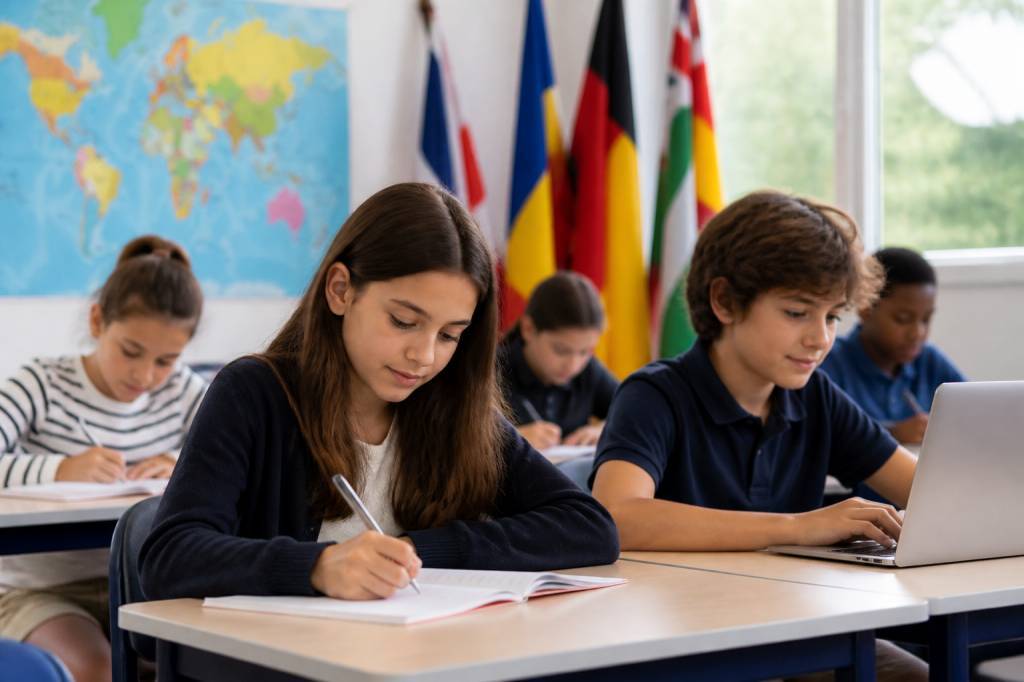
Over the last decade, French schools have experienced a quiet but important transformation. Among the most visible changes is the rapid growth of international sections, programs designed to offer students a bilingual or multilingual education while keeping the structure and academic standards of the French system. What was once considered a niche option for a small number of globally mobile families has become an attractive pathway for students from diverse backgrounds, including French students who want stronger language skills and international exposure.
This rise is not a coincidence. It reflects broader changes in education, migration, career expectations, and parental demand for globally oriented learning. Families increasingly want schools that do more than prepare children for exams. They want institutions that develop adaptability, intercultural awareness, and language mastery. International sections in French schools answer that need while preserving the rigor and identity of the national curriculum.
What international sections are in the French school system
International sections are specialized tracks within French schools that combine the standard French curriculum with enhanced teaching in a foreign language and, often, the study of literature, history, or geography through that language. They exist at different levels, from primary school to lycée, and are commonly associated with a bilingual environment where students are immersed in both academic content and language practice.
Unlike simple language classes, international sections are more immersive. Students may take part of their non-language curriculum in English, Spanish, German, Chinese, Arabic, or other languages, depending on the section. In many cases, the school partners with educational authorities or cultural institutions from the relevant country to ensure a high-quality pedagogical approach.
These programs are especially attractive to families looking for educational continuity across borders. For children who have lived abroad, international sections can help maintain fluency in their mother tongue or another language they already know well. For French students, they offer a gateway to stronger language competence and a more international academic profile.
Why demand has increased so sharply
Several factors explain the rise in popularity of international sections in French schools. One of the most significant is globalization. In a world where higher education, business, and professional mobility increasingly cross borders, parents understand that language skills are no longer optional. English remains dominant, but multilingual ability is becoming a major advantage in school and later in the job market.
Another factor is the appeal of educational excellence. Many families associate international sections with stronger academic performance, small-group instruction, and higher motivation among students. Because entry into these sections may involve selection criteria, they are often perceived as prestigious and demanding, which enhances their appeal.
There is also a social and cultural dimension. France has long been a destination for expatriates, diplomats, researchers, and internationally mobile professionals. As a result, many schools have had to adapt to a student population that is more diverse than before. International sections provide a structured way to integrate students with different linguistic and cultural backgrounds into the French system.
Finally, the growth of digital communication and international travel has changed the expectations of families. Parents increasingly want an education that prepares children not just for the national baccalauréat, but for universities and careers in different countries. International sections make this possible without requiring a complete departure from the French educational model.
The academic benefits for students
One of the main reasons these sections are expanding is the range of academic benefits they offer. Students develop advanced language skills in a real educational context, which usually produces better results than conventional language instruction alone. They learn to understand subject-specific vocabulary, speak more naturally, and think in another language across multiple disciplines.
These programs also strengthen cognitive abilities. Research on bilingual education often shows that students exposed to more than one language at an early age may improve in areas such as memory, concentration, and problem-solving. While outcomes vary from one student to another, the structured use of a foreign language across subjects encourages mental flexibility and analytical thinking.
In addition, international sections can improve motivation. Students are often more engaged when language learning is linked to meaningful content such as literature, history, geography, or science. This practical use of language makes lessons more dynamic and more relevant than isolated grammar exercises.
For many students, these sections also encourage greater confidence. Speaking in another language in front of peers and teachers can be challenging at first, but regular exposure helps reduce fear and hesitation. Over time, students become more comfortable expressing themselves, which can have positive effects on oral presentation skills and public speaking in general.
How French schools are adapting to international expectations
French schools are increasingly aware that they must compete in an international education market. Private institutions, public schools, and bilingual establishments alike have responded by creating more international sections and by improving their linguistic offerings. Some schools now highlight bilingual pathways as a central part of their identity rather than as a secondary option.
This evolution is also visible in school communication and admissions strategies. Parents now compare schools based on language programs, international partnerships, and the mobility opportunities they offer. A french school with a strong international section can stand out significantly in this context, especially for families seeking both academic rigor and global openness.
Schools are also investing in teacher training. To deliver these programs effectively, educators need not only language fluency but also the ability to teach subject content in another language. That requires specific pedagogical skills, cultural sensitivity, and a strong understanding of mixed-language classrooms. As demand grows, so does the need for qualified staff capable of supporting these programs.
In many cases, schools are forming partnerships with foreign education systems or cultural organizations. These collaborations help ensure authenticity in language use and provide students with opportunities for exchange, joint projects, and internationally recognized certifications. Such initiatives make the programs more attractive and more credible in the eyes of parents.
The role of international sections in school diversity
International sections do more than improve language learning. They also contribute to greater diversity within schools. These programs often bring together local students, children of expatriates, and internationally mobile families. The result is a richer classroom environment where students are exposed to a wide range of accents, traditions, and perspectives.
This diversity can be extremely valuable in educational terms. Students learn to interact with peers from different cultural backgrounds, which helps develop empathy, tolerance, and communication skills. In a society where intercultural understanding is increasingly important, these are essential competencies.
International sections can also help reduce the isolation sometimes experienced by foreign students entering the French system. For a child who has moved from another country, the opportunity to join a bilingual or multilingual track can make integration smoother. It provides a familiar linguistic anchor while supporting gradual adaptation to French academic life.
At the same time, French students benefit from being part of an environment that reflects the diversity of the wider world. They gain exposure to different ways of thinking and learning, which can broaden horizons and inspire curiosity about international studies and careers.
Parents’ growing interest in bilingual and global education
Parents today are more informed and more strategic in their educational choices than ever before. Many are actively searching for schools that combine academic strength with language development and international opportunities. This is especially true in cities with large expatriate populations or strong links to global business and diplomacy.
International sections appeal to parents for several practical reasons. They often improve access to foreign universities, support family mobility, and give children a competitive edge in admission processes later on. For families who may move from one country to another, these programs offer continuity. A child who studies in an international section in France may more easily transition into another bilingual or international school abroad.
There is also a perception that these sections open doors professionally. Parents know that languages matter in fields such as commerce, law, engineering, international relations, tourism, and technology. They see education as a long-term investment, and multilingual schooling is increasingly viewed as part of that investment.
Beyond career considerations, many parents value the personal development that comes with multilingual education. They want children to become open-minded, curious, and comfortable in multicultural settings. International sections help nurture those qualities from an early age.
Challenges faced by schools and students
Despite their many advantages, international sections are not without challenges. One of the biggest is accessibility. Because these programs are often in high demand, admissions can be selective. Families may need to demonstrate language proficiency or pass entrance assessments, which can limit access for some students.
Another challenge is balancing linguistic ambition with academic workload. Studying complex subjects in a second language can be demanding, especially for younger students or those without strong prior exposure. Schools must therefore ensure that the pace is appropriate and that support is available when needed.
There is also the question of equity. If international sections are concentrated in certain schools or urban areas, they may widen educational gaps between students who have access to them and those who do not. Public authorities and school leaders must think carefully about how to expand these programs without creating excessive inequality.
Teacher recruitment can be another obstacle. Finding qualified educators who are both language proficient and skilled in bilingual pedagogy is not always easy. Sustaining high-quality international sections requires investment, training, and long-term planning.
- Selective admissions can limit access for some families.
- Students may face a heavier academic workload.
- Schools need specially trained bilingual teachers.
- Uneven geographic distribution can create inequality.
- Program quality depends on strong institutional support.
Why these programs matter for the future of education
The rise of international sections in French schools is more than a trend. It signals a deeper evolution in the way education is understood. Schools are no longer expected to transmit knowledge only within national boundaries. They are now called upon to prepare students for a world in which careers, friendships, research, and cultural exchange increasingly happen across countries.
French schools that invest in international sections are responding to that reality. They are preserving the strengths of the French curriculum while adding a layer of openness, flexibility, and global relevance. That combination is particularly powerful because it offers students both structure and mobility.
For the French education system, this development can also be seen as an opportunity. International sections enhance the country’s attractiveness to foreign families, support language learning for French students, and strengthen the international reputation of French schools. In a competitive educational landscape, this matters.
As more parents seek bilingual or multilingual pathways, and as more students aspire to study or work abroad, the demand for these programs is likely to keep rising. Schools that can respond effectively will be well positioned to meet the needs of the next generation.
What families should look for when choosing a program
For parents considering an international section, the quality of the program should be the main priority. Not all bilingual or international tracks are equivalent, and the best choice depends on the child’s needs, language level, and long-term goals.
Families should examine the balance between language instruction and subject teaching, the qualifications of teachers, the school’s support for non-native speakers, and the availability of international certification or exchange opportunities. It is also useful to ask how the school integrates students from different backgrounds and how it helps them progress academically without feeling overwhelmed.
Another important factor is the future pathway. Some programs are better suited for students who plan to pursue higher education abroad, while others are designed to strengthen English or another foreign language within the French school trajectory. Parents should therefore look for a program that matches both the child’s current profile and future ambitions.
In many cases, visiting the school, speaking with teachers, and discussing the daily rhythm of the section can provide valuable insight. A strong international section should feel structured, supportive, and genuinely bilingual, not simply decorative or marketing-driven.
A growing model for modern schooling
The expansion of international sections in French schools reflects a larger shift toward educational models that are more open to the world. These programs combine language learning, academic rigor, and cultural diversity in a way that appeals to a growing number of families. They are helping reshape what a French education can look like in the 21st century.
As long as schools continue to invest in quality, accessibility, and teacher training, international sections are likely to remain one of the most dynamic features of the French education landscape. For students, they offer a chance to become more fluent, more confident, and more globally prepared. For parents, they provide reassurance that their children are receiving an education that is both rooted and outward-looking.
In a world where the ability to move between languages and cultures is increasingly valuable, the rise of international sections in French schools feels less like an experiment and more like a natural evolution. It is an answer to a modern reality: education must prepare young people not only to succeed locally, but to thrive globally.