Working from home raises a recurring question for many sole traders: can I reclaim the VAT on my home expenses, and if so, how do I record it properly in Xero? I've helped lots of small business owners sort this out, and the short answer is: you can reclaim VAT on the business proportion of expenses only where VAT has actually been charged by the supplier, and you must make a fair, supportable apportionment between business and personal use. Below I walk you through the rules you need to know and a practical, Xero-friendly workflow that I use with clients.
What qualifies and the basic rule
The fundamental principle is simple: VAT can only be reclaimed on purchases that include VAT on the invoice and that relate to your taxable business activity. If an expense is used both for personal and business purposes (mixed-use), you must apportion the VAT and only reclaim the business share.
Typical home expenses where VAT can arise
Examples where VAT may be charged (and therefore potentially reclaimable) include:
Note: many domestic household supplies are charged under different VAT rules. If no VAT is shown on the invoice, there is nothing to reclaim.
How to apportion mixed-use expenses
Apportionment needs to be reasonable and documented. Common methods are:
Whichever method you pick, keep a simple calculation and supporting evidence. HMRC expects a sensible, consistent approach — I recommend documenting your method in a one-page note stored with the invoices.
Practical Xero workflow — step by step
Here’s the process I use in Xero. It assumes you are not on the Flat Rate Scheme and that the supplier has charged VAT.
If the supplier did not charge VAT (for example many household energy bills show VAT differently or are zero-rated for domestic users), you cannot reclaim VAT — but you may still apportion the net cost as a business expense for profit calculation.
Example apportionment — table
| Item | Gross | Business % | Business share (gross) | Recoverable VAT |
|---|---|---|---|---|
| Broadband invoice | £60.00 | 40% | £24.00 | £4.00 (assuming 20% VAT) |
| Phone plan | £30.00 | 50% | £15.00 | £2.50 |
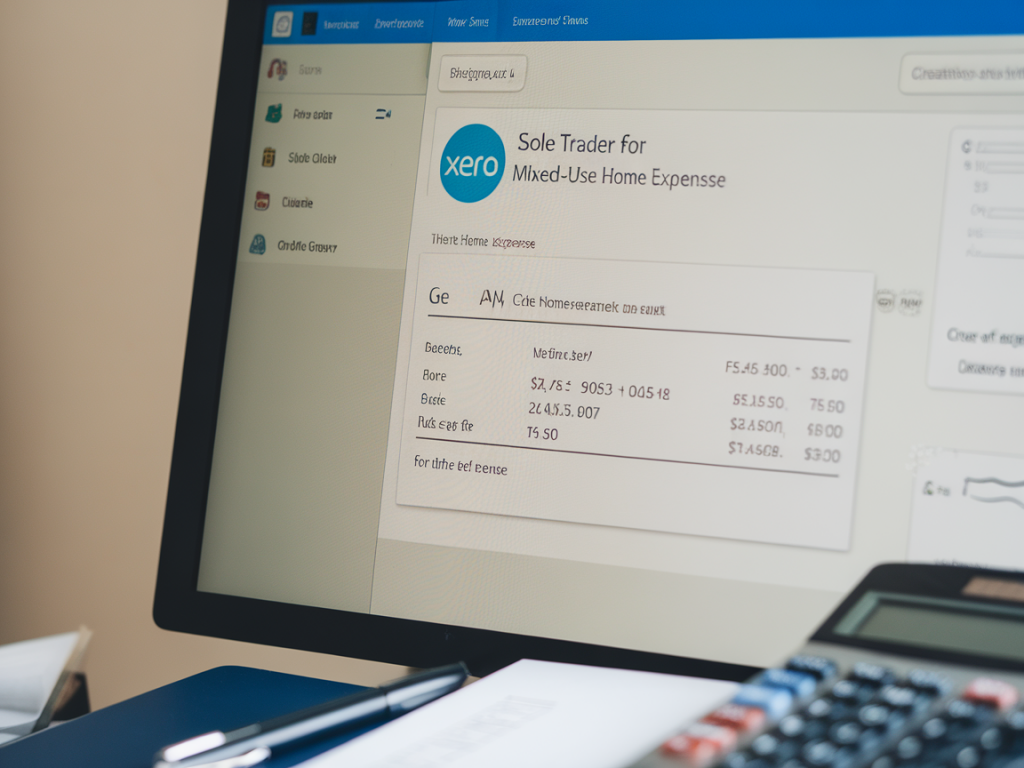
In Xero you would enter the broadband bill split into two lines: £24 at the VAT rate (20%) and £36 to a drawings/personal account. The VAT reclaimable will be the VAT attached to the £24 line (£4). Keep the calculation file with the bill.
Special case: VAT Flat Rate Scheme
If you are on the Flat Rate Scheme (FRS), the general rule is you cannot reclaim VAT on most purchases — the scheme is designed to simplify VAT by applying a fixed percentage to your turnover. There is one notable exception: you can reclaim VAT on capital assets over £2,000 (ex-VAT) even while on FRS. If you are on FRS, check your scheme rules carefully before attempting to reclaim input VAT on home expenses.
Record-keeping and common pitfalls
Some common mistakes I see and how to avoid them:
What to note on your VAT return
Only include the VAT you have legitimately reclaimed (the VAT on the business-proportion lines) in your VAT return input VAT box. If your business makes exempt supplies or is partially exempt, you may need a partial exemption adjustment — speak to your accountant if you’re unsure.
If you’d like, I can prepare a short template spreadsheet you can use to calculate monthly business use percentages and a checklist for filing the supporting evidence in Xero. I also review clients’ Xero setups to ensure the apportionments and VAT coding are correct — happy to help if you want a hand setting this up.