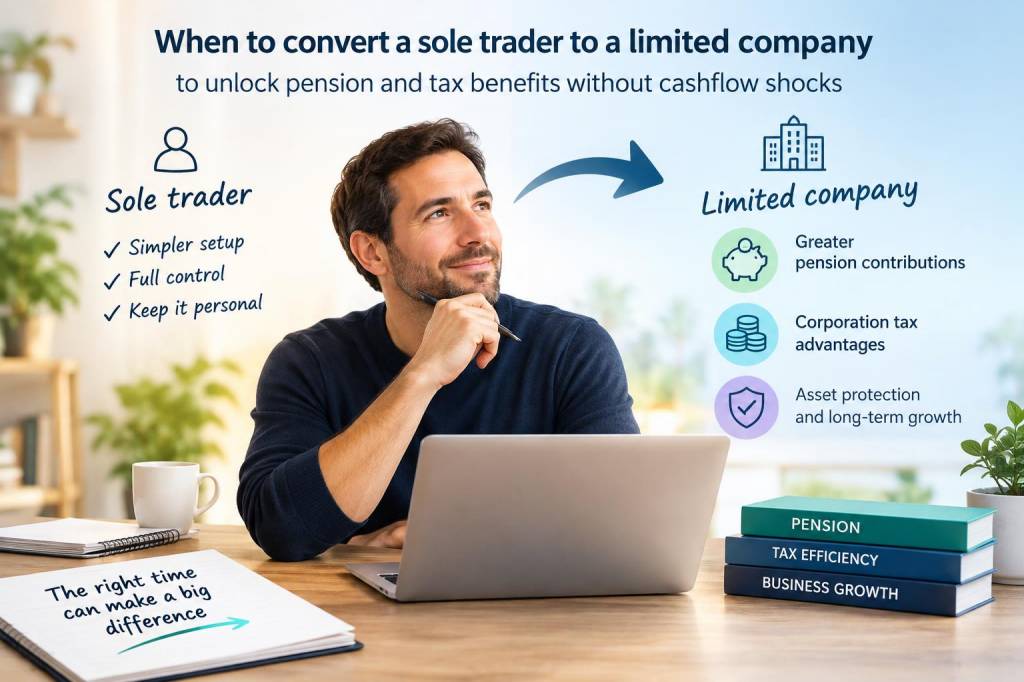
Deciding when to convert from a sole trader to a limited company is one of the most common crossroads I help small business owners navigate. It’s tempting to think the change is purely about saving tax — and while there are definite pension and tax advantages to be gained, timing matters. Convert too early and you may face extra admin and costs that outweigh the benefits; convert too late and you might miss opportunities to shelter income into pensions or structure pay in a tax-efficient way. In this post I walk through the practical signs that suggest conversion makes sense, the pension and tax levers you can pull as a limited company, and how to do it without creating cashflow shocks.
Why conversion can unlock pension and tax benefits
As a limited company, you become an employee and director of a separate legal entity. This gives you more flexibility in how you extract profits: salary, employer pension contributions, dividends and director loans are all options. The two big advantages I see most often are:
Pension-friendly employer contributions — the company can make employer pension contributions that are deductible for corporation tax and don't trigger employee National Insurance Contributions (NICs).Tax-efficient income extraction — paying a low salary up to the NIC threshold and taking the remainder as dividends generally reduces overall tax and NICs compared with sole trader profits taxed as income.Those advantages are most valuable when your business earns enough profit to justify the extra compliance and when you plan to make use of employer contributions to build retirement savings.
Signs it’s the right time to consider converting
Here are the practical triggers I use with clients to decide if conversion is worth exploring:
Consistent net profits above £12–15k per year — there’s no hard cut-off, but once profits are consistently above the personal allowance and into the basic-rate band, the tax savings start to stack up.Profits regularly above ~£30k — this is where the admin and costs of running a company (accounting fees, payroll, filing) are commonly outweighed by tax savings and pension flexibility. For some clients it’s nearer £20k if they plan sizable employer pension contributions.Desire to use employer pension contributions — if you want to maximise retirement saving using the company (particularly important for higher-rate taxpayers or those with irregular income), conversion is powerful.Long-term profit stability or growth plans — if you expect growth, hiring staff, or taking on contracts that prefer limited companies, it’s sensible to prepare now.Concerns about personal liability — limited companies provide more separation between personal and business risks, which can be valuable in some trades.How pension contributions work better via a company
There are a few mechanics that make company pension contributions attractive:
Employer contributions are deductible against corporation tax — so they reduce the company’s taxable profits immediately.No employee NICs on employer contributions — the company pays the contribution and the employee’s NIC position isn’t worsened by that payment.No immediate taxable benefit in kind — pension contributions aren’t treated as income for PAYE purposes, provided they are “wholly and exclusively” for business purposes and the scheme rules are followed.Practical example: instead of extracting £50,000 as salary (subject to employee NICs, employer NICs and income tax), the company could pay a low salary (£12,570), make a £15,000 employer pension contribution and distribute the balance as dividends. The employer pension contribution reduces corporation tax at 19% (or the current rate), boosting overall effective saving into a pension while keeping NICs low.
A simple comparison table: sole trader vs limited company (illustrative)
| Sole trader (profit £50,000) | Limited company (profit before extraction £50,000) |
| Income tax & NICs | Pay income tax and Class 2/4 NICs on full profit | Pay small salary (NICs on salary), dividends taxed at dividend rates |
| Pension option | Personal pension contributions give tax relief at marginal rate | Employer contributions deductible to company and no employee NICs |
| Administrative burden | Lower (self-assessment) | Higher (annual accounts, corporation tax returns, payroll, dividends) |
How to convert without causing cashflow shocks
Switching structure can cause immediate cash demands if you’re not careful. Here’s how I help clients avoid unpleasant surprises:
Model the first-year cashflow — include corporation tax timing, payroll taxes, employer pension contributions, and potential tax on dividends. Many clients forget corporation tax timing differences and fall short.Plan for incorporation costs — accountant fees, payroll setup (I often recommend cloud payroll providers like Xero Payroll or BrightPay), and any VAT or bank account changes.Stagger major payments — if you intend to make a large employer pension contribution in the year of conversion, plan it for a month when cash is available and ensure your accountant records it in the company accounts in the correct tax period.Retain a short cash reserve — three months of running costs is a sensible buffer while you bed in payroll and corporation tax cycles.Handle existing liabilities sensibly — outstanding VAT, PAYE or personal liabilities remain your responsibility as a sole trader; plan to clear them or transfer appropriately before or during conversion.Practical steps to convert
1. Run the numbers — use a simple model to compare take-home pay and pension outcomes as a sole trader vs a company. If you’d like, I provide spreadsheet templates that show salary/dividend/pension scenarios.2. Set up the company — incorporate via Companies House (I often use specialist accountants or online incorporators such as 1st Formations). Choose your share structure and PSCs carefully.3. Open a business bank account — keep company funds separate from personal accounts.4. Register for PAYE and set up payroll — even if you pay yourself a minimal salary, payroll must run monthly or at least be ready to report.5. Decide pension arrangements — confirm the company’s pension provider, auto-enrolment obligations and how employer contributions will be made. Providers I see frequently used include NEST, Smart Pension and Aviva for small companies.6. Transfer assets/contracts thoughtfully — move customer contracts, domain names and any assets into the company where appropriate, and document transfers for tax purposes.7. Close down sole trader VAT/PAYE registrations — or change them to the company where allowed.Common pitfalls I see
Underestimating ongoing compliance costs — small businesses sometimes forget recurring accounting, payroll and reporting fees.Confusing corporation tax timing — corporation tax is due differently to self-assessment; missing deadlines can bite.Auto-enrolment surprise — once you have staff (including yourself as a director if eligible), auto-enrolment duties can apply. Don’t ignore them.Overcommitting pension contributions — while employer contributions are tax-efficient, make sure the company can afford them without compromising operational cash.If you’re weighing this decision for your own business, I recommend starting with a simple model of your expected take-home pay and pension contributions for the next 12–18 months. If you’d like, I can share a spreadsheet and a short checklist tailored to your numbers — drop me a note with a few figures (current profit, expected profit next year, any planned one-off costs) and I’ll help you run the comparison.