Cashflow Management

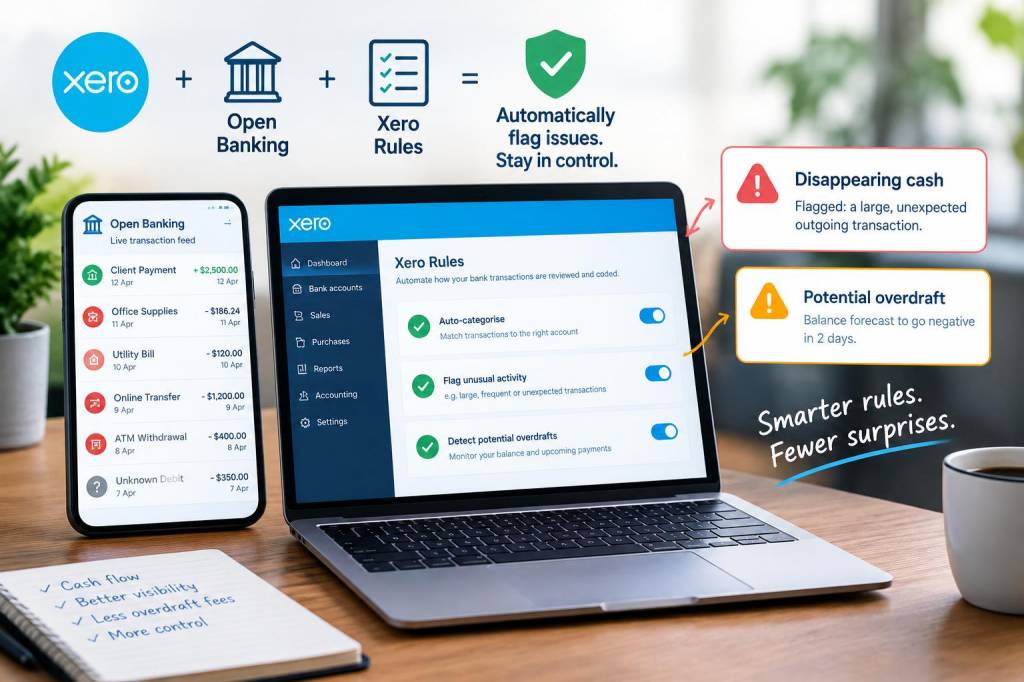
Using xero rules and open banking to auto‑flag disappearing cash and stop surprise overdrafts

Using xero rules and open banking to auto‑flag disappearing cash and stop surprise overdrafts

I want to share a practical way I help clients catch “disappearing cash” before it becomes a surprise overdraft: combine Xero bank rules with open banking-powered balance checks and simple alerts. It’s not glamorous, but it’s one of the best low-effort ways to keep a small business solvent and avoid nasty bank fees.

Why this matters

Small businesses live or die by cashflow. Even when your bookkeeping is tidy, cash can slip away through unmonitored direct debits, unexpected supplier payments, or a cluster of card transactions at month end. Reconciling transactions after the fact is useful for reporting—but it’s too late if your account goes into overdraft.

Using Xero bank rules together with real-time/near‑real-time balance data from open banking gives you two practical advantages:

  • Automated categorisation so you see patterns (and recurring drains) earlier.
  • Balance-triggered alerts so you can act before a negative balance appears.
  • How Xero bank rules help spot the drains

    Xero’s bank rules let you auto-categorise and auto-suggest reconciliation for repeating transactions. That matters because once repetitive withdrawals are consistently tagged, you can:

  • Spot recurring items that were overlooked (old subscriptions, outdated supplier mandates).
  • Group similar payments to forecast their combined impact on a future date.
  • Create saved searches and reports that highlight outgoing patterns by day, supplier or category.
  • Examples of useful bank rules I set up for clients:

    Rule name Matches Action (example)
    Monthly software subs Description contains “Stripe” or “GoCardless” or "SaaS" Tag to “Software” expense account; set reference note “recurring”
    Payroll disbursement Amount between £X and £Y and description contains employer name Tag to “Wages”; mark as cleared
    Bank charges Description contains “CHG” or “FEE” Tag to “Bank charges” and add VAT exemption note

    Those rules save time, but they also surface the items you need to manage. For instance, when “Software” spikes and the rule has flagged ten similar items across multiple cards, it’s obvious you’ve got an unchecked subscription problem.

    Where open banking comes in

    Xero is great at handling transactions, but it isn’t primarily a bank-balance monitoring tool. Open banking allows a third-party app—or a lightweight script—to request your business account balance (with your consent) at scheduled intervals. When you combine that balance feed with Xero’s recognised and recurring transaction data you can:

  • Compare expected balance (based on upcoming direct debits, unpaid bills and payroll) with actual balance.
  • Raise alerts when the actual balance will fall below a safety buffer.
  • Identify timing mismatches (e.g., a large customer payment stuck pending while a payroll payment is due).
  • In practice I use a simple flow:

  • Use Xero rules to keep the ledger neat and identify recurring outgoings.
  • Pull live balances via open banking (providers like TrueLayer or Plaid are common in the UK).
  • Run a short projection that subtracts known upcoming payments from the current balance to calculate “projected available cash”.
  • Trigger notifications when projected available cash falls below a threshold you’ve agreed with the client.
  • Practical setup steps

    Here’s a step-by-step you (or your bookkeeper) can set up in a morning. No developer required if you use one of the apps below; otherwise a freelancer can do the wiring quickly.

  • Audit recurring payments in Xero: Use bank rules, and prepare a short list of all recurring/automatic outgoings, including payroll dates, subscriptions, DDs and standing orders.
  • Decide your buffer: typical buffers for micro businesses are £500–£2,000 depending on monthly turnover and payroll timing.
  • Connect an open banking balance app: choose an app that can fetch balances on a schedule. Options include small cashflow apps that integrate with Xero, or services built on TrueLayer/Plaid.
  • Create a simple projection: current balance minus all items due in the next 7 days (use Xero’s awaiting payments plus upcoming bills/payroll). Many apps can ingest Xero data; if not, export a short CSV.
  • Set notification rules: email, SMS or Slack when projected cash < buffer, and a stricter alert for when actual balance < 0.
  • Test with a client or your own account for a month and refine thresholds and timing (for example, check balances more frequently on payroll days).
  • Which tools I recommend

    You don’t need bespoke software. Consider these categories:

  • Cashflow apps that integrate with Xero (many offer balance pulls using open banking and can send alerts).
  • Banking aggregator services / open banking platforms (TrueLayer, Plaid, Salt Edge) if you’re building something custom.
  • Automation tools (Zapier, Make) that can connect Xero + open banking + Slack/email for alerts.
  • When choosing a vendor, prioritise:

  • Security and FCA compliance.
  • UK bank coverage (some aggregators are stronger than others for certain banks).
  • How they surface alerts — SMS or Slack is faster than email for urgent warnings.
  • What to watch for — common pitfalls

    Two things often undermine these setups:

  • Out-of-date bank rules: if you don’t review them quarterly, merchants change descriptions and your rules stop tagging transactions properly. That hides recurring payments.
  • Timing assumptions: customer receipts can be delayed. A projected surplus can evaporate if an expected client payment stalls. Always treat customer receipts as probable, not guaranteed, unless cleared.
  • To mitigate those risks, I keep two quick routines with clients: a monthly review of their top 10 outgoing payees (to catch new subscriptions or price increases) and a weekly balance check during payroll weeks.

    What this saves you

    Clients who use rules + open banking alerts avoid late fees, reduce overdraft interest and feel calmer. The system doesn’t prevent every cash squeeze, but it turns surprises into manageable decisions: delay a discretionary payment, speed up invoicing, or arrange a short-term overdraft before the bank imposes penalties.

    If you’d like, I can walk you through a simple checklist and sample Xero rule set tailored to your business type (retail, services, hospitality). Send the top three largest recurring outgoings and your payroll cadence and I’ll outline the exact buffer and check cadence I’d recommend.

    You should also check the following news: