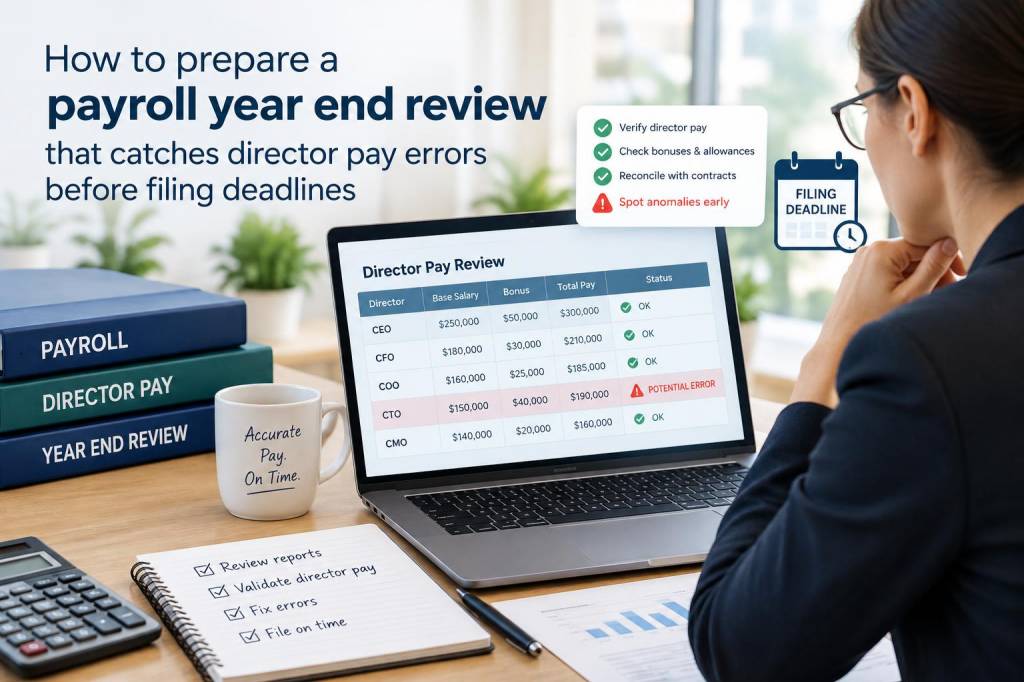
When I review payroll after year end, I am not only checking whether the numbers were entered correctly. I am looking for the small director pay mistakes that can quietly distort a company’s records, trigger avoidable corrections, and create awkward questions when filings are due. Director payroll is often more delicate than ordinary employee payroll because directors can be paid in irregular patterns, bonuses may arrive late, benefits may be reported separately, and software settings do not always reflect how a director’s earnings should be treated across a full tax year.
In my experience, the most useful year-end review is not a rushed last-minute check. It is a structured process that starts with a clear picture of what was supposed to happen during the year, then compares that plan with what actually happened in payroll, bank payments, pension records, and statutory submissions. If I catch an issue early, I can usually fix it before it becomes a filing problem. If I leave it until the deadline is staring me in the face, the correction process becomes slower, more stressful, and more expensive.
Why director payroll deserves a separate review
Directors are often paid differently from other staff. A company may pay a director monthly, quarterly, or only when cash allows. Some directors take a small salary and the rest through dividends. Some are paid through a mix of salary, benefits, reimbursed expenses, and pension contributions. Payroll software can handle much of this, but it still depends on clean setup and consistent inputs.
I always treat director payroll as a separate review because small mistakes tend to repeat across the year. A wrong National Insurance category, an incorrect salary amount, a missed change in director status, or a bonus entered in the wrong pay period can affect both payroll reporting and year-end forms. If I do not isolate director records and inspect them on their own, I can easily miss a pattern that would have been obvious in a dedicated check.
One of the most common issues I see is a director being paid on a cumulative basis, while the payroll was processed as if each month stood alone. Another is a bonus or reimbursement being added without checking whether it should have been taxed, exempt, or handled outside payroll altogether. The point of the review is not just to spot errors, but to understand whether a record reflects a genuine business decision or a data entry mistake.
What I gather before I start
I like to collect every source document before I begin any review. That saves time and prevents me from relying on memory. For director pay, I usually want:
- Payroll reports for every pay period in the tax year
- Director appointment and resignation dates, if any changed during the year
- Employment contracts or board-approved salary notes
- Bonus approvals and dividend records
- Expense claim forms and supporting receipts
- Pension contribution schedules
- Bank payment confirmations
- Previous year payroll summaries for comparison
Once I have those documents, I compare them in a simple sequence: what was approved, what was processed, what was paid, and what was reported to HMRC. This is where many errors reveal themselves. A payroll run may look fine on screen but fail the smell test when matched against bank payments or board minutes.
What I check for director pay errors
The first thing I verify is whether the director was set up correctly in payroll software. That means confirming the correct starter date, director status, payment frequency, tax code, National Insurance category, and any changes made during the year. A surprising number of year-end issues begin with a setup field that was left blank or copied from another employee without checking.
Next, I review pay consistency. If the director was meant to receive a fixed salary each month, I check for gaps, duplicates, and unusual amounts. If pay was variable, I compare each entry against approvals and records. I also look for one-off items, because these are often where errors hide. A bonus may have been posted as regular salary, or a reimbursement may have been taxed when it should not have been.
I also check whether pay was actually made. A payroll report can show a salary line even if the bank transfer failed or was reversed later. That matters because a reported payment that never left the bank account can create confusion when reconciling liabilities and year-end submissions.
Then I look closely at National Insurance and tax. Directors are not always processed in the same way as standard employees, so I want to make sure the calculation basis used in the software matches the real payroll method used throughout the year. If a director joined or left part way through the year, I check whether that change was reflected properly in the calculations.
Finally, I review benefits and expenses. Director pay errors are not always salary errors. Personal use of company assets, private medical cover, mileage claims, home working reimbursements, and phone allowances can all affect the year-end position. If these were handled outside payroll, I make sure they were still captured correctly in the right reports and submitted where required.
My practical review process
I prefer to work through director payroll in a repeatable order, because that keeps the review efficient and reduces the chance of skipping a detail. My process usually looks like this:
- Confirm director identity and payroll setup
- Check each pay run against board approval or payment authority
- Compare gross pay, tax, and National Insurance across the year
- Review any exceptional items such as bonuses or reimbursed costs
- Match payroll totals to bank payments and accounting entries
- Inspect pension deductions and employer contributions
- Check year-to-date totals against the final payroll reports
- Verify reporting to HMRC and any required corrections
This sequence helps me catch both obvious and subtle mistakes. For example, a monthly salary that is consistently £100 too high may be easy to spot once I compare year-to-date totals. A benefit entered twice in one month may only become visible when I compare payroll against the expense ledger. A director who changed tax treatment mid-year may appear correct on the final pay slip but still require a correction in the annual summaries.
Common mistakes I see again and again
There are a few director pay errors that come up so often that I now look for them first. One is forgetting to update payroll after a director change, such as a new appointment, a resignation, or a change in remuneration policy. Another is mixing salary and dividend planning inside payroll records. Dividends are not payroll, but I often see accounting teams use payroll software comments or journals in a way that creates confusion later.
Another frequent issue is the treatment of reimbursements. Some expenses are correctly paid back through payroll, while others should remain outside it. If that distinction is not clear, the year-end records become messy very quickly. I also see directors receiving ad hoc payments that were intended to be bonuses but were processed as ordinary salary without anyone checking the tax and National Insurance effect.
Software settings can create problems too. If a payroll package was migrated, updated, or used by multiple staff members, the director profile may have inherited an old tax basis or an incorrect flag. I never assume software is right simply because it produced a payslip without error messages. I always compare the output to the underlying facts.
A simple table I use during review
| Review item | What I compare | What a problem can look like |
|---|---|---|
| Salary amount | Payroll record, contract, board approval | Repeated overpayment or underpayment |
| Director status | Appointment date, resignation date, payroll setup | Wrong NI treatment or wrong calculation basis |
| Bonus or extra pay | Approval note, bank payment, payslip | Processed in wrong period or taxed incorrectly |
| Expenses | Claim form, receipt, payroll treatment | Taxable item treated as exempt, or vice versa |
| Pension | Deduction report, provider record, bank payment | Missed contribution or mismatch in totals |
| Year-end totals | Payroll summary, HMRC submission, accounting ledger | Figures that do not reconcile |
What I do when I find an error
When I find a director pay error, I do not correct it blindly. I first decide whether it is a payroll error, a reporting error, or both. That distinction matters because the correction route changes depending on what went wrong. A wrong net payment may require a repayment or an additional payroll run. A wrong tax calculation may need an adjustment in the relevant submission. A bookkeeping mismatch may only need a journal, but I still want the payroll side to agree with the records.
I also ask whether the correction affects only one director or the whole payroll process. If the error came from a setup issue, I need to make sure it will not happen again in future pay runs. That is why I always document what I changed and why. A short note saved me many times when I returned to the file weeks later and needed to explain the logic behind a correction.
If a mistake is caught close to a filing deadline, I prioritise the items that affect statutory reporting first. I then clean up the internal records so the payroll file, the ledger, and the director’s pay history all tell the same story. That sequence helps me avoid creating a second problem while fixing the first one.
Questions I ask myself before filing
Before I sign off the review, I ask a few practical questions. Does the director’s pay history make sense for the year? Do the totals match what was approved and paid? Are tax and National Insurance consistent with the intended treatment? Have all benefits, expenses, and pension items been included in the right place? Are there any unexplained differences between payroll reports and the accounts?
If I cannot answer any of those questions confidently, I do not file yet. I go back to the source records and trace the issue from the beginning. In my experience, that extra half hour can save hours of correction later, especially when a filing deadline is close and everyone is relying on the numbers being right.
For me, the value of a payroll year-end review is not only in catching mistakes. It also gives me confidence that director pay has been handled in a disciplined way throughout the year. That matters because directors often sit at the centre of company finance decisions, and their payroll records should be as clean and traceable as any other core financial process.