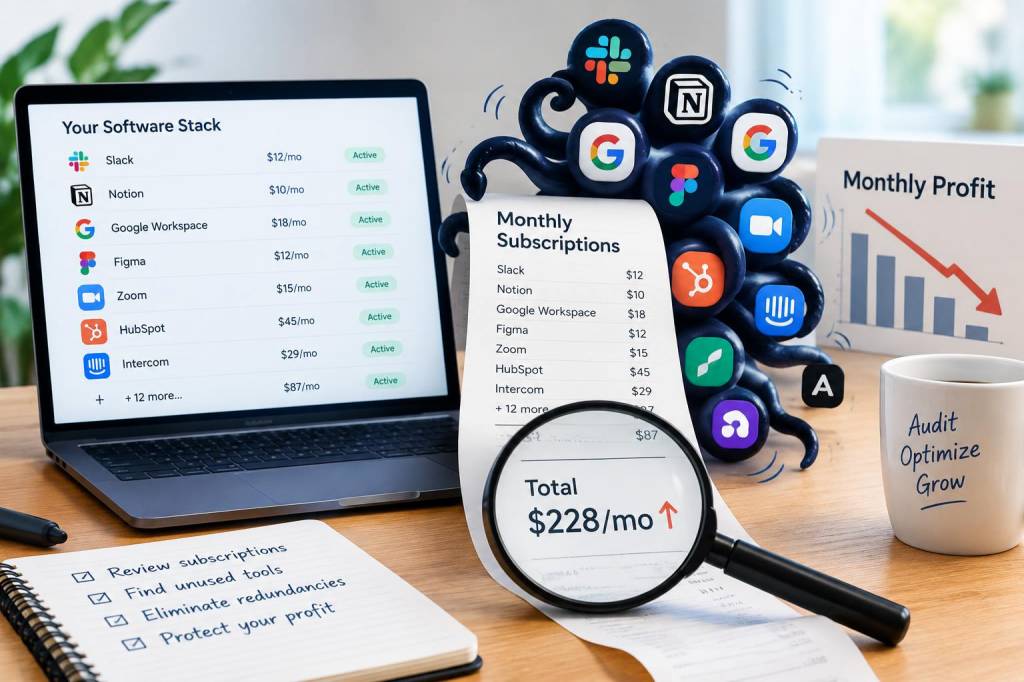
Software spending often starts small enough that I barely notice it. A design app here, a scheduling tool there, an extra inbox add-on because someone on my team wanted a faster workflow. Each charge looks harmless on its own, and that is exactly why subscription creep can do so much damage. It rarely arrives as one dramatic bill. It arrives in fragments, hidden inside ordinary monthly renewals, until profit starts to feel tighter for no obvious reason.
When I review cashflow for small businesses, I see the same pattern again and again. Owners know their revenue, know their rent, and know their payroll, but they cannot always explain why their software stack has become so expensive. A few years ago, many businesses could run on a lean set of tools. Now there is often a separate subscription for accounting, project management, file storage, e-signatures, email marketing, reporting, customer support, time tracking, and security. If nobody is actively managing that stack, monthly profit slowly leaks away.
Why subscription creep is so easy to miss
Subscription creep is sneaky because it hides inside convenience. When a tool saves time, I am naturally more forgiving of its cost. That is sensible, but it becomes dangerous when convenience stops being measured against value. A subscription can stay active long after the original need has faded, especially if the renewal happens automatically and the invoice lands in a busy inbox.
I have also found that software costs are often spread across different parts of a business. Marketing might pay for one platform, operations for another, and finance for something else entirely. In that situation, nobody sees the full picture. The result is a stack that has grown by accident rather than by design.
Another reason it slips through is that many software charges are small enough to feel irrelevant. A monthly fee of £12 or £19 does not seem worth investigating, yet ten tools at that level quickly become a meaningful expense. Add several premium plans, extra user seats, annual renewals, and a handful of forgotten trials, and the total can become painful.
Signals that a software stack is starting to bloat
When I suspect subscription creep, I look for a few practical warning signs.
- Multiple tools are doing similar work, such as overlapping project management or email marketing platforms.
- Staff members have access to licences they no longer use.
- Free trials have converted into paid plans without a clear decision.
- Monthly invoices have risen, but no one can explain which tools drove the increase.
- Team members avoid a platform because it is clunky, yet the subscription remains active.
- Annual plans renew automatically, and the renewal date is only noticed after payment.
- Reports, dashboards, or automations are paid for, but no one checks whether they are still being used.
If several of those sound familiar, I would treat that as a signal, not a coincidence. A software stack should earn its place every month. If it does not, it is quietly reducing profit.
What I do first when I review software spend
I start with a complete list. Not a partial list, and not a list built from memory. I want every recurring software cost in one place, including card payments, direct debits, app store charges, annual renewals, and costs paid through different departments. The simplest approach is to review business bank statements for the last three to six months and capture every recurring supplier name.
Once I have the list, I sort each tool into one of four groups:
- Essential and actively used.
- Useful, but possibly replaceable.
- Rarely used, but still worth keeping for a specific reason.
- No longer needed.
This simple sorting exercise usually reveals more than people expect. A tool that felt essential six months ago may now be in the wrong group. A platform may still have value, but not at its current price. A tool may be used by only one person, while the rest of the team has switched to a different system.
I also check whether each subscription is linked to a clear business outcome. For example, does a marketing platform help generate leads, track conversions, or improve retention? Does a collaboration tool reduce admin time enough to justify its cost? If I cannot connect the subscription to a useful outcome, I become much less tolerant of the expense.
Questions I ask before renewing anything
Before I keep, cancel, or downgrade a subscription, I ask a few simple questions.
- Who uses it regularly?
- What problem does it solve?
- What happens if it disappears tomorrow?
- Can another tool already do this job?
- Has usage fallen over time?
- Are we paying for features nobody touches?
- Would a lower plan still meet our needs?
Those questions are useful because they force a business case. I am not looking for perfection. I am looking for honest value. A subscription does not need to be perfect to survive, but it does need to justify its place in the monthly profit calculation.
I have often found that businesses keep premium plans simply because nobody wants to face the hassle of change. That hesitation is understandable, but it can be expensive. In many cases, a lower tier or a different provider would achieve nearly the same result at a far lower cost.
Where hidden costs usually sit
Subscription creep is not always obvious from the headline price. I watch for hidden cost layers that make a tool more expensive than it first appears.
| Cost area | What I look for | Profit risk |
|---|---|---|
| User seats | Unused logins, ex-staff access, duplicate accounts | Paid capacity that delivers no value |
| Feature tiers | Premium plans kept for one feature only | Overpaying for unused functionality |
| Add-ons | Extra modules, analytics packs, support upgrades | Small charges that accumulate quickly |
| Annual renewals | Auto-renewal at a higher rate than expected | Cashflow pressure and weak negotiation power |
| Integration fees | Paying to connect tools that should work together | Increased admin without stronger output |
One thing I especially watch is the gap between licence count and active use. Many platforms charge by seat, but very few businesses regularly review whether every seat is still needed. If a staff member leaves, changes role, or no longer uses the platform, that licence should be reviewed immediately.
What I do to stop creep from returning
A one-time cleanup helps, but it will not solve the problem forever. To stop the issue from returning, I build a simple monthly habit around software review. I do not need a complicated process. I need consistency.
Each month, I compare actual software spend with last month’s total. If the cost has increased, I want to know why. If a new subscription appears, I want someone to explain it. If a plan upgrades automatically, I want that decision recorded. That small amount of discipline keeps the stack under control.
I also like to assign clear ownership. Every subscription should have a named owner, even if the finance team pays the bill. That owner should be responsible for reviewing usage, renewal dates, and whether the tool still serves its purpose. When nobody owns a subscription, it tends to survive by default.
It also helps to maintain a renewal calendar. A shared calendar or spreadsheet with supplier names, renewal dates, notice periods, and current monthly or annual cost can prevent surprises. If a contract needs notice before cancellation, I mark that date prominently. That one habit has saved me from more unwanted renewals than I can count.
What I say when a tool is genuinely worth keeping
I am not anti-software. A strong tool can save hours, improve accuracy, and make cashflow easier to manage. When I decide to keep a subscription, I want to be able to explain why. The strongest reasons usually look like this:
- It saves measurable time every month.
- It reduces errors or rework.
- It improves visibility over sales, costs, or cashflow.
- It supports compliance or record keeping.
- It replaces several weaker tools at once.
If I can point to a real saving, I am happy to keep paying. For example, a platform that automates invoice reminders may be far cheaper than the time it saves. A bookkeeping app that cuts manual data entry can pay for itself quickly. A marketing tool that supports lead tracking may justify its fee if it genuinely improves conversion. Value is not about price alone; it is about return.
How I make the decision to cancel, downgrade, or keep
When I face a subscription decision, I try to stay calm and practical. I separate emotion from economics. If a tool is familiar but underused, I usually ask whether a lower plan would work first. If the lower plan still feels excessive, I consider cancellation. If the team actively depends on it and the numbers make sense, I keep it.
I also think about switching costs. Sometimes a tool looks expensive, but replacing it would require training, data migration, and disruption. In those cases, I do not cancel lightly. I weigh the subscription cost against the cost of moving away from it. That said, I do not use switching friction as an excuse to keep bad spending forever.
My rule is simple: if a subscription does not support current business priorities, I want a clear reason for keeping it. If there is no clear reason, it should not be in the stack.
Practical actions I would take this week
- Download business bank transactions and identify every recurring software payment.
- List each tool, its owner, renewal date, and monthly or annual cost.
- Mark unused licences and duplicate functions.
- Check whether any annual renewals are due within the next sixty days.
- Review whether lower plans or cheaper alternatives would meet current needs.
- Cancel trials that have become paid plans without a clear business decision.
- Set a monthly software review into the finance calendar.
When I do this properly, I usually find a mix of quick wins and longer-term improvements. Some savings are immediate, such as removing duplicate subscriptions. Others take a bit more work, such as replacing a fragmented toolset with a simpler system. Either way, the effect on monthly profit can be meaningful very quickly.
What matters most is making software spend visible. Once it is visible, it becomes manageable. And once it is manageable, it stops behaving like background noise and starts behaving like a real business decision.