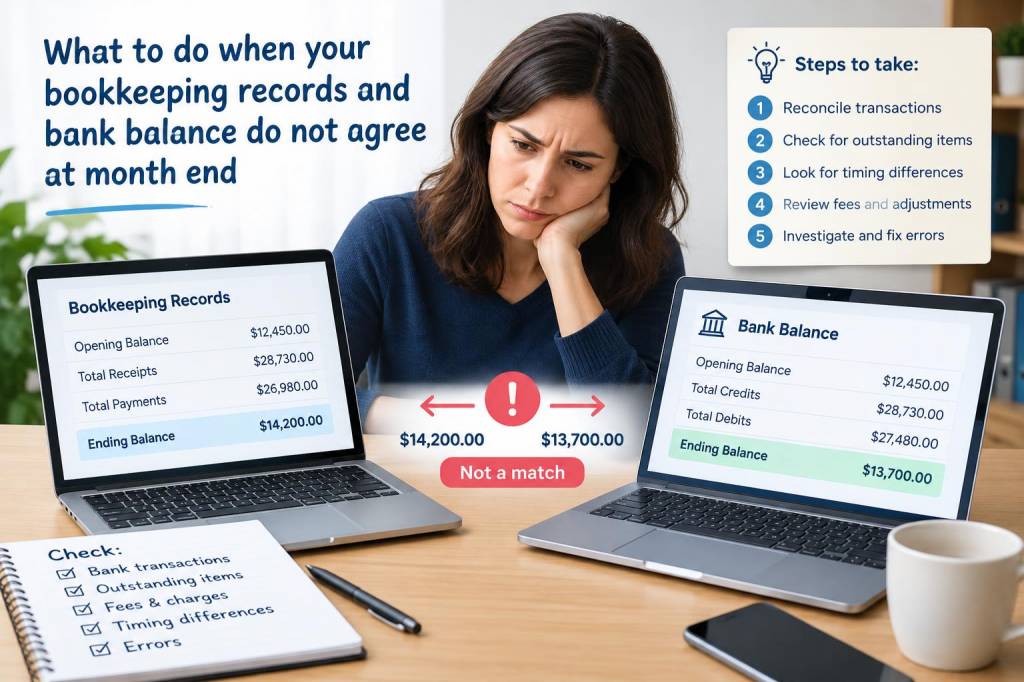
When my bookkeeping records do not agree with my bank balance at month end, I treat it as a signal, not a disaster. In practice, this mismatch usually means one of a small number of things has happened: a transaction has been missed, duplicated, entered in the wrong period, recorded with the wrong amount, or simply not yet cleared by the bank. For small business owners, that gap can feel unsettling, especially when you are trying to close the month, review cash flow, or prepare information for a tax return. My approach is always to slow down, work methodically, and avoid guessing.
I have seen this problem in sole trader records, limited company accounts, and busy owner-managed businesses where the day-to-day pace makes it easy for small errors to build up. The good news is that most differences are fixable once you know where to look. The key is to separate timing issues from genuine mistakes and to use a repeatable process every month. That habit saves time, reduces stress, and gives you cleaner records for decision-making.
Start with a calm reconciliation mindset
Before I search line by line, I remind myself that a difference between bookkeeping records and the bank balance does not automatically mean something is wrong in a serious way. Often, the issue is simply that my records include items the bank has not yet processed, or the bank has applied a charge or payment that I have not entered. The first job is to identify whether the difference is a timing issue or a data issue.
I like to begin with a fresh reconciliation view for the period end. I compare my accounting software balance with the closing bank statement balance, then I check whether all items on the statement are accounted for in the books. If I use software such as Xero, QuickBooks, Sage, or FreeAgent, I make sure the bank feed has fully synced before I start searching for errors. A partial feed update can make a clean set of records look wrong.
Check for common month-end causes
In my experience, a mismatch at month end usually comes from one of a handful of causes. I work through them in a consistent order so I do not waste time jumping around.
- Unpresented payments or receipts that have not cleared the bank yet.
- Bank charges, card fees, interest, or direct debits that have not been posted.
- Duplicate entries in the bookkeeping records.
- Transactions entered for the wrong amount.
- Transactions coded to the wrong bank account.
- Transfers between accounts that have been entered only once.
- Items recorded in the wrong month or wrong accounting period.
- Opening balance errors carried forward from a previous reconciliation.
One of the most useful habits I have developed is checking whether the difference is a neat round number. If the gap is exactly £10, £50, or £100, I immediately suspect a missing payment, a duplicated receipt, or a bank charge. If the gap is odd, I look more closely at partial entries, transposed numbers, or splits that were coded incorrectly.
Compare bank statement lines against ledger entries
My preferred method is to compare the bank statement line by line against the bookkeeping ledger. I start at the top of the statement and work through each item. For each line, I ask myself three questions: has it been recorded, has it been recorded once only, and has it been recorded in the right way?
If I cannot match a bank transaction to a ledger entry, I look for common variations in wording. Card processors, payroll providers, and online payment platforms often use descriptions that are not immediately familiar. A supplier payment may appear under a shortened trading name, and a customer receipt may be grouped through a payment gateway rather than show the client’s name directly. That is why I never rely on memory alone. I check the source document, email notification, invoice, or payment confirmation before I decide an item is missing.
I also pay close attention to transfers between accounts. A transfer from one business account to another should appear as one payment and one receipt in the overall records. If only one side has been posted, the bank balance will not agree even though both accounts are actually correct in real life.
Look for timing differences first
Timing differences are common and often harmless. A cheque may have been written but not yet cleared. A card payment may have been authorised near the end of the month but settled a few days later. A supplier direct debit may have left the bank after month end, even though the cost belongs to the current month. These items do not always mean the bookkeeping is wrong, but they do need to be understood and documented.
When I find a timing issue, I do not force it into the wrong month just to make the reconciliation look neat. I record it in the period it belongs to, then note that it is outstanding at month end. That approach gives a truer picture of business performance and avoids distorting cash flow reporting.
Investigate unexplained differences with a structured search
If the issue is not a simple timing difference, I move into a more detailed search. I use a structured approach rather than scanning randomly, because random searching wastes time and increases the chance of missing something obvious.
I usually check the following in order:
- Whether any bank statement lines are missing from the books.
- Whether any book entries have been duplicated.
- Whether a figure has been entered with an extra zero or a digit missing.
- Whether a payment was posted against the wrong customer or supplier.
- Whether a refund, reversal, or chargeback has been handled correctly.
- Whether cash deposits have been split incorrectly across dates.
- Whether petty cash or expense reimbursements have been entered twice.
If I still cannot find the difference, I use a simple audit trail approach. I trace the movement of funds from source to bank and back again. For example, if a customer payment was received through Stripe or PayPal, I check the sales invoice, payment confirmation, processor fee, and bank settlement together. This often reveals that the gross payment and net settlement were confused, which is a very common source of month-end mismatches.
Pay close attention to opening balances
An imbalance at month end is sometimes caused by a problem that started much earlier. An incorrect opening balance can survive for months and only become visible when the books are reconciled carefully. I always check that the opening bank balance in my bookkeeping system matches the actual bank statement at the start of the period. If it does not, every later reconciliation will be distorted.
This is especially important when bookkeeping systems have been changed, when a file has been imported from another platform, or when a business has started using a new bank account. Even a small opening error can create a persistent mismatch that looks much larger than it really is.
Use a clear table to sort the difference
When I am training clients or reviewing records with a bookkeeper, I often use a simple table to sort transactions into categories. It helps me see whether the mismatch is explained by timing, error, or missing information.
| Item | Possible cause | What I check |
|---|---|---|
| Bank charge | Not posted | Bank statement, charge description, accounting entry |
| Supplier payment | Entered twice or not at all | Supplier ledger, payment run, bank reference |
| Customer receipt | Wrong amount or wrong customer | Invoice, remittance advice, payment gateway report |
| Transfer between accounts | One side missing | Both bank accounts, transfer date, ledger entry |
| Card transaction | Net amount only posted | Gross amount, processor fee, settlement record |
Record adjustments properly instead of forcing a match
When I do find the cause, I make the correction properly rather than forcing the figures to agree in a way that hides the real issue. If a transaction is missing, I enter it with the correct date and code. If something has been duplicated, I reverse the duplicate entry. If a payment belongs to the wrong account, I reclassify it. If the mismatch comes from a bank fee, I record the fee separately so the bookkeeping reflects what actually happened.
This matters because month-end bookkeeping is not only about agreeing to the bank. It is also about producing records that support management decisions, VAT returns, year-end accounts, and cash flow planning. A quick fix that makes the balance look right but leaves the transaction wrong will create more work later.
Know when to ask for outside help
I am comfortable digging into records myself, but I also know when to step back. If a difference remains unexplained after a careful review, or if several months are affected, I bring in another set of eyes. A second reviewer can spot patterns that I may have missed, especially if the issue is linked to a system setup problem, bank import error, or earlier accounting change.
It is also sensible to ask for help when the difference is material. If the mismatch could affect VAT, management accounts, supplier confidence, or director reporting, I do not leave it unresolved for long. The longer a mismatch sits in the file, the harder it can be to untangle.
Build habits that prevent future mismatches
Once I have solved a month-end difference, I look for a way to reduce the chance of it happening again. Prevention is usually easier than repair. I keep bank reconciliations current during the month rather than leaving everything to the end. I review uncoded bank items regularly. I use consistent naming for accounts and suppliers. I also make sure transfers, fees, and refunds are posted as soon as they appear.
For small businesses with limited time, a routine matters more than perfection. A short weekly check is often enough to catch errors before they become awkward month-end surprises. I prefer a practical rhythm: review the bank feed, clear obvious items, investigate anything unfamiliar, and leave only the genuinely unclear items for deeper review.
When I stay disciplined with reconciliation, I gain more than accurate books. I get a clearer view of cash flow, faster month-end close, fewer unpleasant surprises, and more confidence in the numbers I use to run the business. That is why I never ignore a difference between bookkeeping records and the bank balance, even when it seems small at first glance.