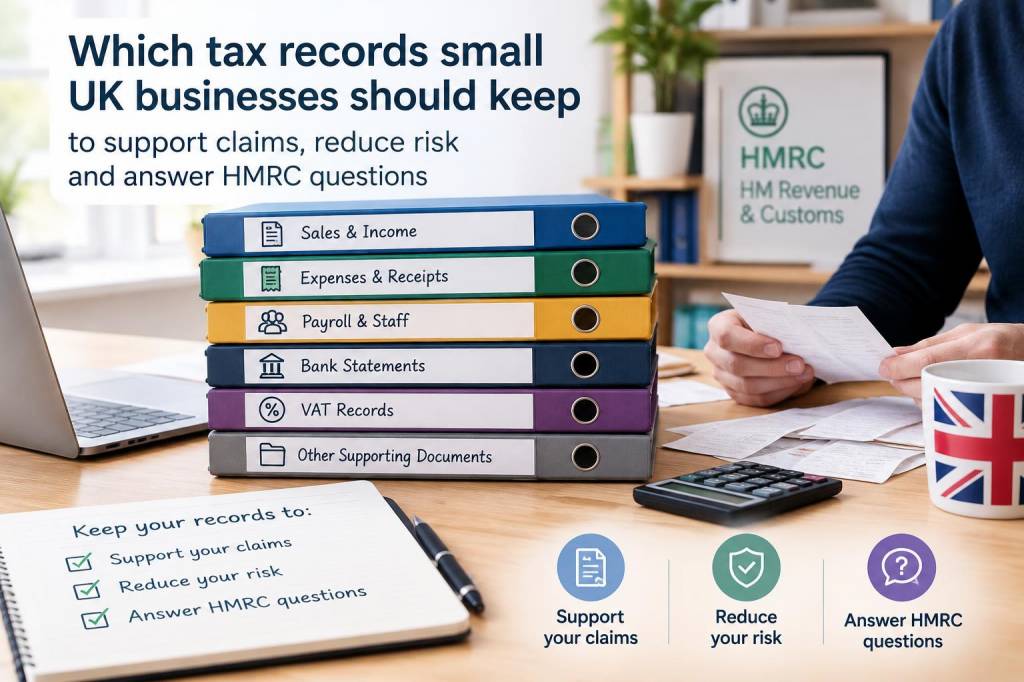
When I speak with small business owners about tax records, I usually hear the same worry: “What if HMRC asks me to prove something and I cannot find it?” That concern is sensible. Good record keeping is not just about staying organised; it is about protecting claims, lowering error risk, and making tax returns far easier to defend if questions arise later.
I think of tax records as a business shield. If your figures are clear, complete, and easy to trace, you can support expenses, justify income, and explain choices with confidence. If records are patchy, even a genuine claim can become difficult to prove. That is why I encourage clients to keep records with a simple rule in mind: if it affects tax, cash flow, payroll, VAT, or a claim, keep it.
Income records I would keep from day one
Every business needs a clear trail of income. This matters whether you are a sole trader, a partnership, or a limited company. I always recommend keeping copies of:
- Sales invoices
- Receipts for cash sales
- Point-of-sale reports
- Online platform statements
- Bank statements showing customer payments
- Credit note records
- Refund documentation
If you sell through Amazon, Etsy, Shopify, eBay, Uber, Deliveroo, or another platform, save the platform statements as well as your bank records. I have seen many businesses rely only on bank entries, but platform fees, chargebacks, refunds, and commission deductions can all affect taxable income. A bank feed alone does not always tell the full story.
For businesses that take card payments, I also like to keep merchant summaries from providers such as Stripe, Square, or Worldpay. These summaries help explain why the amount paid by customers is not identical to the amount that lands in the bank.
Expense records that support deductions
If you claim business expenses, you need evidence that each cost was genuinely incurred for business purposes. HMRC will usually expect a record that shows what was bought, when it was bought, who supplied it, how much it cost, and why it was business related.
I would keep:
- Supplier invoices
- Itemised receipts
- Order confirmations
- Proof of payment, such as bank or card statements
- Delivery notes where relevant
- Contracts for recurring services
- Subscription renewal notices
This applies to ordinary day-to-day costs such as postage, software, stock, training, stationery, insurance, advertising, phone costs, rent, and professional fees. If a supplier issues a receipt only, I still keep it. If a supplier issues an invoice only, I keep that too. The aim is to build a complete audit trail.
One area where I see avoidable mistakes is mixed-use spending. If you buy something for both business and personal use, keep a note explaining the business element and the basis for any apportionment. For example, if your phone contract covers business and private use, your record should show how you worked out the business share. That note can save a lot of trouble later.
Bank records, card statements, and cash records
Bank statements are not optional in my view. They are one of the most useful records for proving the flow of money through a business. I suggest keeping statements for every business account, savings account, and credit card used for business purposes.
If you handle cash, I would also keep:
- Daily cash takings summaries
- Cash count sheets
- Cash payment logs
- Safe float records
- Banking slips for cash deposits
Cash records matter because they are often the first place where errors, missing income, or unexplained differences appear. Even small cash businesses benefit from a daily or weekly cash summary. It gives you a simple way to check that sales, till balances, and banked amounts all agree.
Payroll records I would never discard too early
If you employ staff, payroll records deserve special care. HMRC can ask about pay, deductions, benefits, and pension contributions, and you need a clean record trail. I keep the following for payroll matters:
- Employee contracts
- Right to work checks
- Timesheets or attendance records
- Gross pay calculations
- PAYE and National Insurance reports
- Pension auto-enrolment records
- Statutory payment records, such as sick pay or maternity pay
- RTI submissions and payroll summaries
If you use software such as Xero, QuickBooks, Sage, or BrightPay, keep exports or backups of payroll reports as well as the live software data. Software is helpful, but I never assume that one platform alone is a permanent archive. I prefer having copies stored in a second location too.
VAT records that can save time during a review
For VAT-registered businesses, record keeping becomes even more important because input tax, output tax, and partial exemption issues can all create questions. I would keep:
- VAT invoices issued and received
- VAT return working papers
- Digital records used for Making Tax Digital
- Import VAT evidence
- Export documentation
- Reverse charge calculations
- Evidence for zero-rated or reduced-rate supplies
VAT is an area where I strongly prefer complete records over short notes. If you claim input VAT on an invoice, keep the full invoice. If you apply a special VAT treatment, keep a note explaining why. If you use software to bridge data into your VAT return, save the reports that show how the figures were built.
I also encourage clients to keep evidence for any bad debt relief claims, fuel scale charge calculations, or business entertainment adjustments. These are small items individually, but they can matter when HMRC looks at a return in detail.
Records for capital purchases and fixed assets
Large purchases often need more than a simple receipt. Equipment, vehicles, laptops, machinery, shop fittings, and other fixed assets should have records that explain cost, date, supplier, and business use. I would keep:
- Purchase invoices
- Finance agreements
- Lease contracts
- Mileage logs for business vehicles
- Asset registers
- Depreciation schedules
- Disposal or sale records
If you later sell an asset, the sale record matters too. It may affect capital allowances, balancing charges, or taxable gains. I often see businesses keep the purchase record but lose the disposal record, which leaves a gap in the story. I prefer a full lifecycle file for each major asset.
Claims, allowances, and reliefs need proof
Some records matter because they support a specific claim rather than an ordinary expense. This is where careful evidence really pays off. If you are claiming mileage, home office costs, use of business premises, professional subscriptions, staff training, charitable donations, or research and development relief, I would keep the records that prove eligibility.
Useful evidence can include:
- Mileage logs with date, journey, purpose, and distance
- Home working calculations
- Utility apportionment notes
- Meeting agendas and travel evidence
- Training invoices and course outlines
- Donation receipts and Gift Aid records
- Project notes, timesheets, and technical documentation for R&D claims
In practice, HMRC is not only asking whether a claim exists; it is asking whether you can show how it was arrived at. A few lines in a spreadsheet are often enough if they are consistent and supported by source documents.
Digital records and backups matter as much as paper
I still meet business owners who keep a shoebox of receipts and hope that will be enough. It is better than nothing, but I would much rather see a digital system with reliable backups. Scan paper receipts quickly, file them by category and tax year, and store copies in at least two places if possible.
I like a simple folder structure such as:
- Income
- Expenses
- Banking
- Payroll
- VAT
- Assets
- Tax returns
- HMRC correspondence
If you use cloud accounting software, keep exports of key reports from time to time. That gives you protection if software access changes or data becomes corrupted. I also advise saving HMRC letters, emails, notices, payment confirmations, and any response you send to them. Those messages can become very important if a question comes back months later.
How long I would keep different records
Retention periods vary depending on structure and record type, but I always urge clients to keep records for long enough to cover potential checks and queries. In most cases, I would keep tax and accounting records for at least six years. For some records, longer retention is sensible, especially if they relate to assets, property, pensions, payroll issues, or disputes.
| Record type | My usual retention approach | Why it matters |
|---|---|---|
| Sales and purchase records | At least six years | Supports tax returns and expense claims |
| Payroll records | At least six years | Supports PAYE, NI, and employment matters |
| VAT records | At least six years | Supports VAT returns and adjustments |
| Asset records | Six years after disposal | Supports allowances and gain calculations |
| HMRC correspondence | At least six years | Shows what was asked, answered, and agreed |
Even if a document is old, it can still matter. I have seen queries arise years later over a vehicle, a home office claim, or a long-running contract. When that happens, the business with organised archives is in a much stronger position.
What I tell clients when a record feels minor
My rule is simple: if a record helps explain a tax figure, keep it. That includes ordinary receipts, but it also includes notes, screenshots, emails, booking confirmations, delivery evidence, mileage logs, and working papers. A lot of tax defence comes down to telling a clear, believable story backed by evidence.
If you are ever unsure whether something is worth saving, I would save it. It is far easier to delete an unnecessary file later than to recreate a lost one after HMRC asks for it. I would rather have an extra folder than a missing invoice, a missing bank statement, or a missing explanation for a claim.